



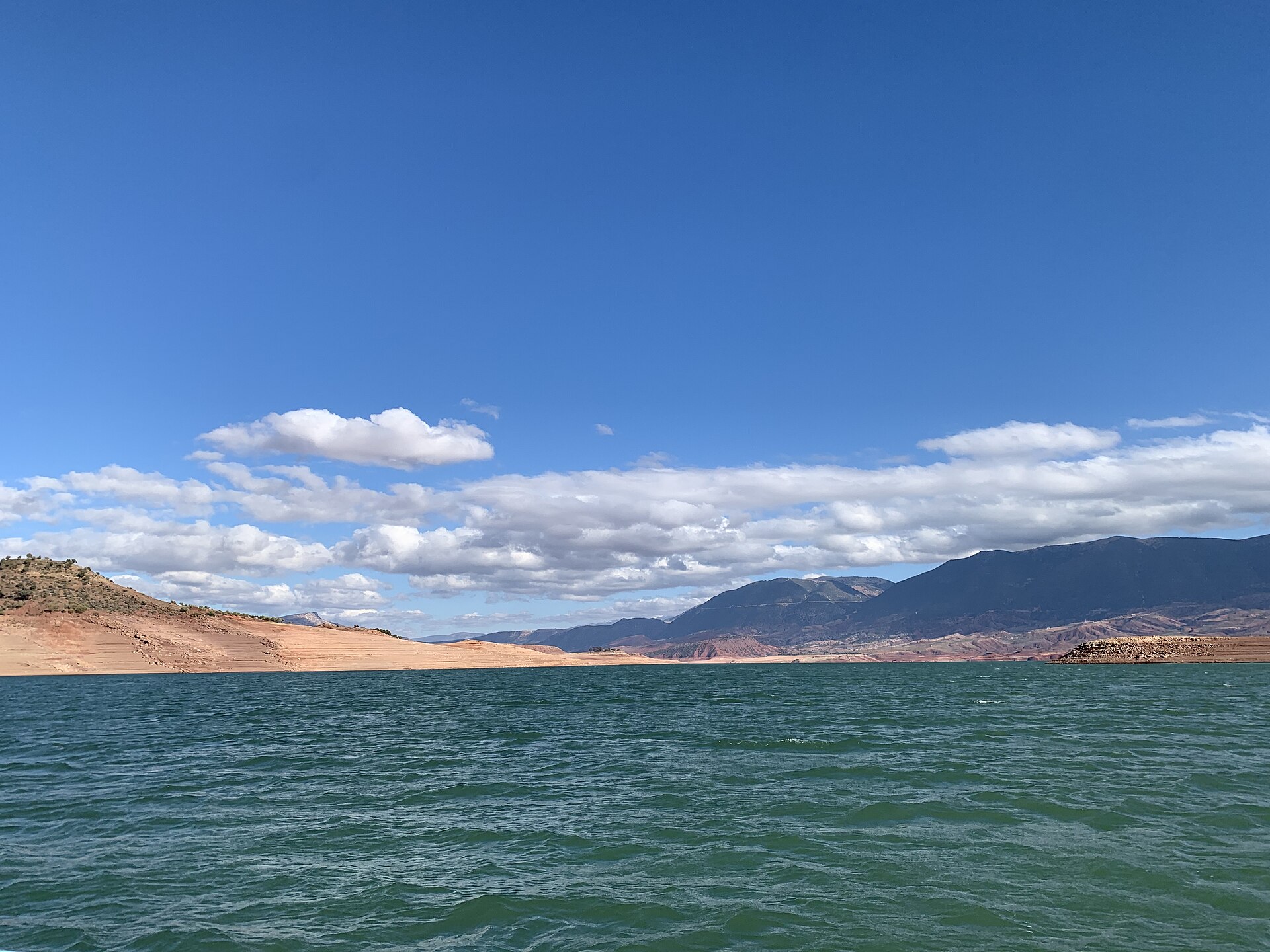
Illustrative photo — The Bin el Ouidane reservoir, in Morocco. Credit: Najlae Lrhorfi — Wikimedia Commons, CC BY-SA 4.0 license.
This photo does not depict the people mentioned in this article.
As of November 20, the national filling rate of Moroccan dams reached 66.16%. On the same date a year earlier, it was at 31.22%. While the increase is significant nationwide, it doesn't indicate the amount of water supplied to a specific municipality or the amount that will be available for a given agricultural season.
These daily figures from the Ministry of Water were reported on November 21st by Le360. Reservoirs totaled approximately 11.27 billion cubic meters as of November 20th. Between November 5th and 20th, the volume increased by approximately 52 million cubic meters. Over this two-week period, the national rate thus rose by about 0.3 points. The year-on-year recovery and the changes over the last two weeks therefore tell two different stories.
The Moulouya and the Souss-Massa at different levels
According to figures published by Le360 for the same date, the Moulouya River reached 71.5% capacity and the Souss-Massa River approximately 53%. Both basins were fuller than a year earlier. However, they are not entering the rest of the season with the same percentage of their available capacity.
The water level of a dam can also be lower than the average for its basin or the national average. Al Massira, a dam located in the Oum Errbia basin, showed nearly 42% of its capacity, according to the reported reading. A classification by percentage indicates the proportion of the capacity occupied. To compare the actual volumes of water stored, the size of the reservoirs must be known.
On November 17, Le Matin reported on Minister Nizar Baraka's update regarding water reserves and severe weather management. At that time, the minister placed the national level at around 66%. This statement provides another recent benchmark. The comparisons between basins mentioned above, however, are based on the same date.
A dam that's two-thirds full doesn't describe the water coming out of the tap.
The reservoir level indicates the amount of water stored in the reservoirs. Distribution then depends on the networks and how the resources are allocated among different uses. Therefore, drinking water supply and irrigation cannot be directly determined by the reservoir level alone. The state of the groundwater or the specific challenges of a local network require additional data.
For Moroccans living in Canada who are following the situation in their region of origin, the most useful figure is often that of the watershed serving their relatives. If a family has questions about irrigation, they will also need information on local decisions regarding the agricultural season. If they have questions about drinking water, the information from the water utility serving their municipality is what matters.
The national increase indicates a measurable improvement in stocks. To determine whether this translates into concrete changes in a region, it is necessary to monitor basin-level data and distribution decisions throughout the season.
Sources: Ministry in charge of Water (Morocco), daily situation of dams on November 20, 2026, reported by Le360 on November 21, 2026; Le Matin, November 17, 2026.